31 August 2006

Basic Color Theory for Desktop

Reproducing consistent color can be the most difficult part of the design and production process. Yet it's often something that gets taken for granted until a proof or the final output reveals that you didn't get the colors you expected: The bright red apple that you photographed, scanned, and placed in PageMaker has lost some of its luster, and you're perplexed at why this should be.
Unfortunately, it's natural. You can't get the apple on your printed page to look like the apple you hold in your hand. It can look similar, but not the same, and it's all due to the nature of color and the processes used to reproduce it.
The phenomenon of seeing color is dependent on a triad of factors: the nature of light, the interaction of light and matter, and the physiology of human vision. Each factor plays a vital part and the absence of any one would make seeing color impossible.

In broad terms, we see color when a light source that emits a particular distribution of differently colored wavelengths of light strikes a colored object. The object reflects (or transmits) that light in another particular distribution of colored wavelengths, which is then received by the photoreceptors of the human eye. The photoreceptors are sensitive to yet another particular distribution of wavelengths of light, which is sent as a stimulus to the brain, causing us to perceive a particular color:


The Nature of Light and Color

Light is electromagnetic (EM) radiation, the fluctuations of electric and magnetic fields in nature. More simply, light is energy and the phenomenon of color is a product of the interaction of energy and matter. As a reasonable starting place for discussing color, we need to take a brief look at the physics of light and the particular nature of light sources. Light has the properties of both particles and waves. Light particles, called photons, radiate from their source in a wave pattern at a constant speed of 186,000 miles per second. Like waves in the ocean, light waves have a crest and a trough. They are measured by wavelength, the distance between two crests (in meters or, sometimes, in ångstroms which are 1/100,000,000th of a meter), and by amplitude, the vertical distance between the crest and the trough. The human eye is only sensitive to EM radiation at wavelengths that range roughly between 780 nanometers and 380 nanometers. This small segment is called the visible spectrum or visible light. This is usually what we mean when we speak of "light" (though, properly speaking, all EM radiation is light). Infrared lies just below red light; ultraviolet exists just above violet light. Both are invisible to humans and other creatures (though some reptiles can see infrared and some insects can see ultraviolet). The visible spectrum contains numerous colors that are distinguished by wavelength and amplitude; wavelength determines color and amplitude determines brightness. Of these colors, the human eye can distinguish about 10,000. The visible spectrum, however, is often identified by the seven prominent colors we see in the rainbow. In 1666, Isaac Newton named these colors red, orange, yellow, green, blue, indigo, and violet, which are often referred to by the mnemonic acronym ROY G BIV.


Light Sources

Light comes from a variety of sources. Because color depends on the reflection of light from an object, the nature of the light source is of the utmost importance. The most obvious light source in our experience is the sun; other obvious sources include flame and various kinds of electric lamps. There are still others that might not be as obvious, such as the phosphors that make sea foam glow.
We have already characterized light as energy. In general, then, any process that emits, re-emits, or conducts energy in sufficient amounts produces light. The most common means are the following:

IncandescenceSolids or liquids heated to 1000 K or greater emit light. The sun is a natural incandescent source (at about 5800 K on the surface), so is a candle flame. The most common man-made source is the tungsten filament light bulb at about 2854 K.


Gas DischargeGases emit light when an electric current passes through them. The nature of the light depends on the gas used as the conductor. The gas is typically at very low density to facilitate conduction, though variations in the density of the gas changes the nature of the light produced. Common types of gas discharge sources are sodium, mercury, and xenon lamps.


PhotoluminescencePhosphors are substances that absorb and then re-emit light. In doing so they change the nature of the absorbed light. When the re-emission takes place concurrent with the absorption, the source is called florescent; when the re-emission continues after the light is no longer being absorbed, it is called phosphorescent. The obvious example of a photoluminescent source is a florescent lighting tube (which is actually a mercury lamp coated inside with phosphors).

NB: Photometry is the measurement of the attributes of light, though it is more commonly used to refer to measuring its intensity or flux. Luminous intensity, or luminance, refers to the amount of energy in a light source and is measured in units called candelas.


Regarding Customers

Who is a customer, what could be the role to handle this very "critical turn of prospect to enquiry to customer" stuffs. During an international summit in CeBIT, in Germany, I had sumbitted a presentation. I actually do not have those slides today with me, but yes, this is a professional blog, I do not mind to share the ideas which I have today (and those days too) about a customer. When you become a customer, what do you expect, what do you think.

If you've had the personal experience of waiting endlessly in the express line at your bank, it's a pretty fair assumption that you weren't happy. Your experience totally redefined the term of personal stress and you vowed to move your accounts elsewhere. Professionally, you have placed repeated calls to a component supplier-whose parts are vital to your production-and no one is available to check inventory levels. This not only impacts your mood, it impacts your bottom line.

As a customer, you demand quality service. And, this is really the bottom line.
When we do business, we do work for somebody, your customers are no different. If you understand their needs and exceed their expectations, you ensure success. Disappoint them, you run the risk of losing business. To grow a steady stream of top line revenue, you must develop more and loyal customers. This is well-known that the cost of acquiring and retaining customers is substantial.

Significantly decreasing these costs while providing superior levels of customer service is important to the survival of your business.

At the same time you are building a solid customer base and driving sales, it's critical to focus your efforts on streamlining your entire operation. Streamlining means things like reducing expenses by improving order processing efficiency, maintaining fill rates while reducing inventory carrying costs and lowering hard-dollar sales transaction costs and giving you a competitive advantage and allowing you to spend more time solving real business problems.

I expect your comments based on this.

21 August 2006

Strategy


During the years of teaching, I had presented this following presentation to students.

Editing Modes

Software reference: Adobe Premiere, Avid Media Express

Offline Editing

In offline editing, you edit video using lower-quality copies of the original clips and produce the final version on a high-end system. Offline editing was developed to save money by editing in a less expensive facility. Although offline editing can be as simple as writing down time points for scenes while watching them on a VCR, it is increasingly done using personal computers and Premiere. Once you have completed the offline edit in Premiere, you create a table of scene sequences called an edit decision list, or EDL. You then move the EDL to an edit controller on a high-end system, which applies the sequence worked out in Premiere to the original high-quality clips. In this way, the editing work done on the less-expensive workstation is used to create the final cut on the more expensive, higher-quality workstation.

When you digitize video for offline editing, you specify settings that emphasize editing speed over picture quality. In most cases you need only enough quality to identify the correct beginning and ending frames for each scene. Because you will be generating an EDL from your edits, be sure all clips are captured with frame-accurate timecode that corresponds exactly to the timecode of the high-quality source video that you will use for the final online edit. If you plan to edit offline using VHS dubs (copies) of the source clips, be sure that in each dub you burn in the timecode—make the timecode visible in a window in the picture. These steps ensure that the EDL you generate is usable when transferred to the online system or edit bay and that your edits will be frame-accurate. See Reading timecode from source video.

Offline editing techniques can be useful even if your computer can handle editing at the quality of your final cut. By batch-capturing video using low-quality settings, you can edit the faster, using smaller files. When you’re ready to create the final cut, you can redigitize the video at the final quality settings.

Online Editing

Online editing is the practice of doing all editing (including the rough cut) on the same computer that will produce the final cut. Previously, online editing had to be done on expensive high-end workstations designed to meet the picture quality and data processing requirements of broadcast-quality video. Editors with high-end requirements who could not afford a suitable online system had to rent time at a production facility that owned one. As personal computers have become faster, online editing has become practical for a wider range of productions. With high-end personal computers, online editing is practical for broadcast television or motion-picture film productions.

For online editing, you’ll capture clips once at the highest level of quality your computer and peripherals can handle.

Note: When you edit Digital Video (DV) format clips, all editing is online. At the time this guide was written, the DV format did not allow creation of a low-resolution version at import time. However, DV compression makes standard DV manageable on many systems.

EDLs

What is EDL?
An edit decision list (EDL) is necessary when you use Premiere for offline editing and plan to complete editing of source videotape or motion-picture film in a post-production studio. An EDL contains the names of original clips, the In and Out points of those clips as they are used in a video program, and other editing information such as split edits, depending on the EDL format.

Additional Information on EDL: Premiere can export an EDL in formats compatible with various edit controllers, including CMX, Grass Valley, and Sony BVE. A generic EDL format is also provided. Supported EDL formats exist as plug-ins stored within the Plug-ins folder inside the Premiere folder, so you can add support for a new EDL format in the future if a Premiere-compatible plug-in becomes available.

Behavior and Functions of Audio in EDL

Because Premiere works with files on a computer instead of tapes, it controls sound in a way that differs significantly from traditional editing systems. Traditional tape-based editing systems are designed to record from (and to) one or more audio tracks on the videotape, or onto a separate audio tape recorder. Premiere provides up to 99 audio tracks in the Timeline for placement of audio clips; however, when you play or export video, Premiere produces a single track that can contain more than one channel (such as left and right). In Premiere, mixing of audio tracks is controlled by the fade and pan controls that accompany each audio track. The standard EDL has no way to mix sound, except for the mixing that occurs when one audio source dissolves into another audio source.

3D Basics

If we work with the definition of 3Dimensional Space with the boundaries that define our WORKSPACE or SCENE, then the simplest way to do this is to imagine that we are working inside a large cube. We can imagine that this cube as our world or environment. Objects that exist within the cube one visible, those that fall outside are invisible.

The main point of reference in this world is called the World Origin. This origin is usually located in the center of this Space. But, it can also be placed or repositioned elsewhere depending on the modeling needs and straights.

The ORIGIN is a point of reference usually located in the center of the three dimensional space. It can also be located elsewhere in 3D Space. a 3D Space has width, height and depth dimensions each represented by the three axis in the cartesian coordinate system.
Rene Descartes-the founder of Cartesian Coordinate System, formalized the idea of using three axes labelled X,Y and Z to represent the dimensions in three dimensional Space. The coordinate system he devised is commonly referred to as the Cartesian or Rectangular coordinate system. Each axis in the system can be divided into many units of measurements. In principle these units of measurements and scales of dimension. On each axis the values to one side of the origin are positive and the values on the other side are negative.
Any World or global Coordinate System is usually useful for placing or moving objects in the world or in relation to each other. World Coordinates are absolute values that are relative to the origin of the world. These coordinates do not depend on any specific object in the world and are applied to all objects in the world in the world indistinctly.

a A POINT can be defined by its XYZ Position.
b A LINE can be defined by the XYZ location of its two endpoints.
c A PLANAR SURFACE can be defined by the position of its bounding lines.


Transformation
Geometric Transformations can be performed on single objects or on entire environments. Transformation that are applied to the objects using the environment’s axes and/or origin are called Global Transformations. When transformations are applied to a single objects or a limited selection of objects- using the objects own axes and origin, they are called Local Transformations.
CONCENTRATED TRANSFORMATION is the name sometimes given to a series of global transformations applied in sequence.

Translation
Translation is the simplest of all geometric transformations. This operation is used to move an object or group of objects in a linear way to a new location in 3D Space. Translation is the simplest, and easiest to control, of all geometric transformations. Translation can occur along one axis or along several axes at the same time.

Rotation
Rotation is the geometric transformation used to move an element or group of elements around a specific center and axis. The amount of rotation is usually specified in terms of an angle of rotation (measured in degrees) and a direction of rotation.
Rotations can be used to present the different sides of an object to the camera lens (directed towards the object).

Let us think about HIERARCHY. Depending on whether the rotation is global or local. Objects can be rotated around their “parent” in a hierarchy of objects. When rotating an object around its own center it is possible with many programs to reposition that center. Consequently, the center of rotation of an object may not always be placed in the geometric center of the object.


03 August 2006

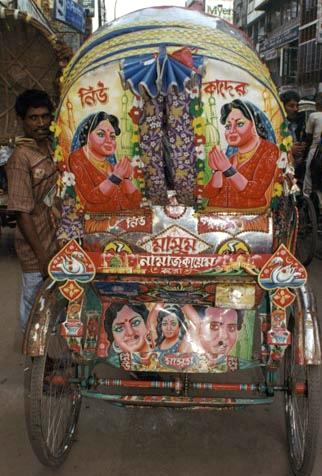
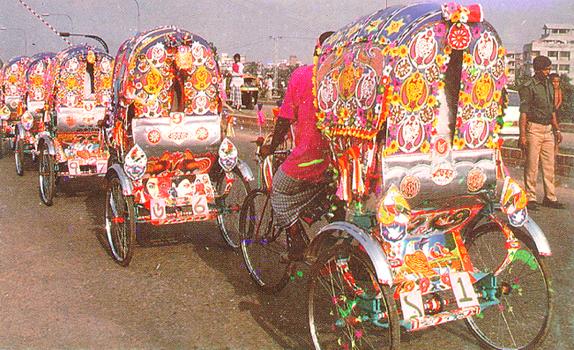
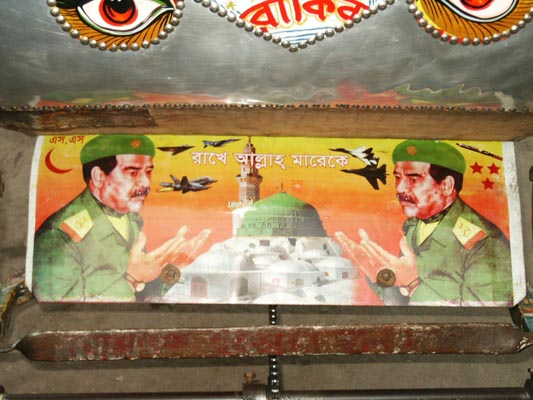
Rickshaw Art in Dhaka


Images Courtesy: Google Images and all photographers who had taken these candid shots.

01 August 2006

Have you seen the GHOST!!


In the year of 2004, I met director of this company in SoftExpo 2004 in Dhaka and there was a delegation from Denmark comprises of managers and decision makers from this country visiting Dhaka for outsourcing opportunities. I had a very successful discussion with them during this period.
I was actually representing my previous organization for some projects on industrial level graphic design and 3D visualization services. As a 3D lover, I really liked and value their works. Ghost is undoubtedly the best 3D production and post production company in scandanavia region and Ghost consists of a team of professional and creative people with many years of experience in the production of 3D Graphics and Vfx, for feature films as well as TV and advertising.

See what they have spoken about themselves-
"Since the humble beginnings in a caravan in 1999, Ghost has strived to make 3D Graphics and Visual Effects of the highest quality.Today, we have moved on from borrowed desks and a leaky tent.We now reside in an office consisting of 5000 square feet over two floors, with 2 suites and a frightening amount of computer hardware, without a caravan in sight."

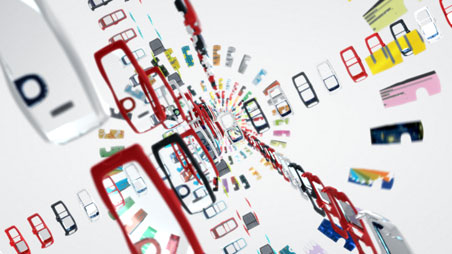
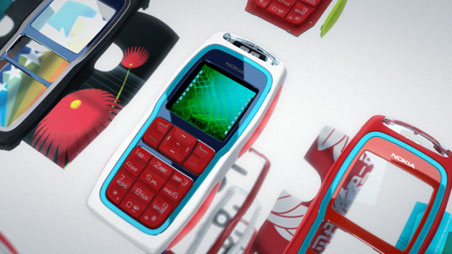
Here, I would like to copy and paste a small textual content from their one of the best productions for Nokia mobile which was advertised thru media worldwide. You have also seen this, if you are a TV-freaker. I have taken the following texts and above images from their site www.ghost.dk. Cheers for them !

Grey Copenhagen won the bid to create an advert for the global launch of Nokia's new phone, the 3220 and they in turn hired Ghost to make the film in 3D. The Nokia 3220 has a host of different accessories you can clip on to personalize it, most notably a backplate that enables the user to write light-messages in the air.The advert illustrates the countless ways the phone can be customized and hundreds of phones are shown on the screen, while they assemble, detach and move in complicated patterns.The first step was an animatic made with low-rez geometry, which was repeatably tweaked and adjusted. This happened in close collaboration with the agency and the director, until the sequence was finalized. At the same time, CAD-models from Nokia were adapted and optimised for use in Maya.The deadline on the project was very tight considering the level of ambition: 12 different versions of the film had to be ready in 4 weeks.In order to handle the vast number of polygons and minimize the number of re-renders and render-layers, we decided to render out the whole film in Renderman.The film was delivered in 2K and broadcast globally.

Few Words on architectural 3D modeling and design process


Computer Aided Design and Modeling programs are used into the architectural process, and modern technologies have refined the process to the point that tools like AutoCAD/3DSMAX are now essential to the architectural design process.
An example of where a computer holds the edge over a model is in the field of sun studies. The appropriate location and orientation of a building structure affects the amount of natural light that enters into it, and the way this light behaves with the whole structure. I have used 3DSMAX since it hits the market and from my experiences I have seen this can run simulations of the position bright sun to show what the ambient light levels would be like in various rooms of the building at different times of the year. In fact, by calculations, you can adjust the settings in the software. This can actually save a large amount of time in the design process, because attempting to make these calculations by hand would be unrealistic now a days, since we have such tools to do it for us.

Models of buildings, solid structures also enable you to present your work to your clients and receive feedback without having to go through time consuming expense of building a physical model. Actually, you can demonstrate different orientations to cleint online , that means, using computer software tools like 3DSMAX, changes or modifications to the exisiting design can be implemented so quickly and our effort gets reviewed by the clients so that by the time the final review process begins, all angles have been thoroughly explored.

3D animations for architecture evolved slowly compared to other forms of 3D applications. This was due to a shortage of budgets, expertise and computer power. But times have changed and animation is now expected.


Images show my design effort of King Room suite at Hotel Intercontinental, Dhaka and Exterior Structure of Holiday Inn Dhaka. These designs were made with several other designs within Year 2003-2004. I had led a team of design professionals from my workplace and graduate architects from University of engineering and technology.


Design visualization


Design is driven by emotions. Design visualization could be defined at its simplest as the simulated representation of a design concept and its contextual impacts or improvements. Interesting and strategic visual messages are essential in creating and maintaining positive relations with the audience. Corporate communications, internal communications are the direct links between a business and its investors, employees, customers and the people. Design for marketing takes on a variety of forms. Magicframe has developed many dynamic and functional design systems that enable our customers to tell their story.